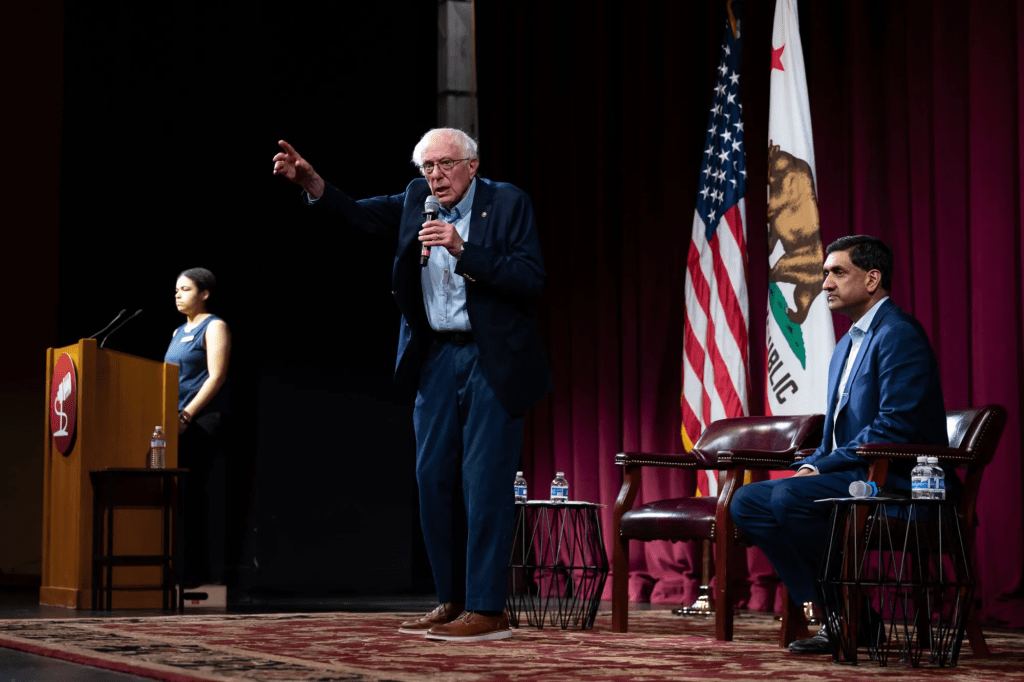
By Evan Kim ‘29 and Alex Mondragon ‘26
On February 20th, Senator Bernie Sanders of Vermont and House Representative Ro Khanna (CA-17) came to speak for a Stanford Speakers Bureau event on the future of AI. The talk started with both politicians delivering monologues of their own, expressing their thoughts on the current state of artificial intelligence innovation, its implications, and what our nation’s response should be.
Sen. Bernie Sanders’ Monologue
Senator Sanders, after walking out to thunderous applause, emphasized the caution we should be taking with artificial intelligence considering the speed of its development. Calling this the “most dangerous moment” in our country’s modern history, he expressed fears for our current preparedness for “the most profound technological revolution in world history.” He also highlighted the unprecedented scale and scope of the inevitable change that AI will bring, voicing concerns for the threat to our democratic institutions, the global economy, emotional well-being, education, and how children are raised. Additionally, he drove home his belief that AI is neither good nor bad — what we should instead be asking ourselves is whether it will be the billionaires or the people that are going to benefit the most from this society-altering technology. In AI innovation, humans must be the first priority so that it is used as a tool that enhances our work, not one that takes the work away.
Referencing Elon Musk, Jeff Bezos, Peter Thiel, and more, he warned against the further concentration of wealth that these figures’ investments in artificial intelligence could cause, and called for more regulation and a “moratorium” on the growth of data centers in the US. Referring to future artificial intelligence developments as a “tsunami” that the American people are not ready for, Senator Bernie Sanders called on the audience to make America proud and rise to the occasion in responding to the threats that AI could pose.
House Rep. Ro Khanna’s Monologue
Representative Ro Khanna shared similar sentiments to Sen. Sanders, honing in on the need to address wealth concentration disparity and the importance of putting humans first in AI development. To offer a clear, distinct response effort, Rep. Khanna outlined seven principles to address concerns of AI’s future impact.
- Keep humans in the loop — design AI to augment not replace humans (e.g., retain human operators for critical roles)
- Worker bargaining & shared gains — require large companies to bargain with unions and share AI productivity via wages, profit‑sharing, shorter workweeks
- Correct tax/market distortions & data rights — remove incentives favoring automation, implement an annual data dividend and a Data Bill of Rights
- Build a Future Workforce Administration — national, publicly funded jobs and training program (funded by a modest wealth tax and token AI tax) to create public‑service jobs and tech/trade schools
- Data centers must serve local communities — require local benefits, compute access for schools/libraries, local jobs, renewable energy, and full cost accountability
- Protect democracy & public discourse — prevent weaponization of platforms (limit engagement‑driven amplification, require platform openness)
- Democratic AI governance & competition policy — strong federal regulation, antitrust enforcement, and support for open/accountable AI models
Q&A
After both Congressmen gave their address and elicited their concerns about artificial intelligence encroaching on the United States job market, students were given the chance to pose questions. During the Q&A session, Senator Sanders and Representative Khanna fielded questions on a variety of topics, including immigration, education, and even advice on leadership.
Most notably, when asked about the current state of the United States immigration system and the operations of the Immigration and Customs Enforcement agency, Representative Khanna denounced the system in its entirety: “We need to tear down the agency and replace it.” Khanna continued to reflect on the current removal tactics used by the Immigration and Customs Enforcement agency, claiming the agency has no oversight or sense of democratic accountability. Senator Sanders added remarks about the nature of targeting immigrants, criticizing the President for focusing on vulnerable minority groups.
The following students brought the focus to the conversation surrounding AI in the workforce and shared overwhelming concerns for job stability in the new age of automated labor. Senator Sanders responded with a call to action against oligarchs, stating that the influence of corporations on government operations is too great. Sanders continued by urging students to get involved in grassroots campaigns to protest computerized labor, reducing the need for human employment. Sanders finished his point by reiterating an earlier sentiment that AI is inherently neither good nor bad; rather, it is the utilization of AI that has the potential to threaten social processes.
Representative Khanna and Senator Sanders concluded the Q&A session with students by reminding the youth to remain involved in their democratic responsibilities. Co-chairs of the Stanford Speakers Bureau closed the event by thanking both congressmen for their appearance and gifting them with Stanford merchandise.
Photo Credit: Seeger Gray

 Stanford Political Review
Leave a reply to Lindsay Felipa Cancel reply