By Lavi Sundar ’26
The hectic season of course registration has descended upon Stanford undergraduates, and surveyors of ExploreCourses (or Navigator, but let’s be real—that’s a harder sell) might have noticed a new potential option on their dashboards: CSRE 3S1. The class, subtitled “Confronting Systemic Racism and Advancing Policy Change in the U.S. Criminal Justice System”, is offered on Monday afternoons and can be taken for 1 – 2 units.
As related courses like PHIL 175 (Philosophy of Law: Protest, Punishment, and Racial Justice), CSRE 264 (History of Prisons and Immigration Detention), or ANTHRO 338A (Policing and the Carceral State) do not appear to be offered this academic year, this class seems like a particularly timely addition to the catalogue.
But that’s not the only interesting part. Students more experienced with the rigors of Stanford course enrollment will have caught the ‘SI’ suffix to the course code, an indicator of a student-initiated and/or devised class. Established by ASSU in the early 2000’s2, student-initiated courses embody Stanford’s spirit of academic freedom, self-directed learning, and self-advocacy—allowing student leaders, aided by faculty sponsors, to write syllabi, assign readings, and lead lectures.
In this instance, the students in question are members of the Stanford ACLU’s Education Committee, headed by Shelby Boulware-Johnson (’27) and Madeline Sinclair Jones (’28), aided by faculty sponsor Dr. Shaina Hammerman. Being a member of the committee myself, I sat down with them to get their thoughts about the upcoming class and insight into the syllabus formulation process.
“We felt like there was kind of a gap in Stanford’s offerings in this area, and we really wanted to fill that gap,” Boulware-Johnson said, when asked about the ideation process. She added that they wanted to “particularly focus on systemic racism and inequality from the perspective of the life cycle of the system, like, looking at how a person enters the criminal justice system, what are the historical precedents underlying the criminal justice system? What are the prison conditions that people endure within the criminal justice system? And then…beyond that, how do people get put there in the first place? Predictive policing, police brutality, looking at how technology is kind of enabling these things, and thinking about the school-to-prison pipeline.”
Boulware-Johnson noted that these topics were not randomly selected, but a result of “seeing where [Education Committee members’] passions lay.” Indeed, the entire ideation process has been an exemplar of collective work. In a Google document shared with a large and ever-evolving team, students from a variety of disciplines pitched in, threading a tapestry of varied interests and academic backgrounds. In this way, over two years, the syllabus and curriculum took shape: as granular as week-by-week topics and readings, and as high-level as grading policies and slideshow presentations.
One particularly notable aspect of the class is its policy proposal final project—an option for students to be innovative and put into action what they’ve learned. Sinclair emphasizes how she hopes this can bring a spirit of hope and optimism to the classroom: “The policy focus, I think, is one of our biggest strengths, because it’s really teaching people to not just point out a problem, but, okay, what can we do about it? And especially in our current political system, I’d like something teaching people to be like, okay, not only can we take action, taking action works, looking at the legacy of people fighting for reform, and how that has helped.”
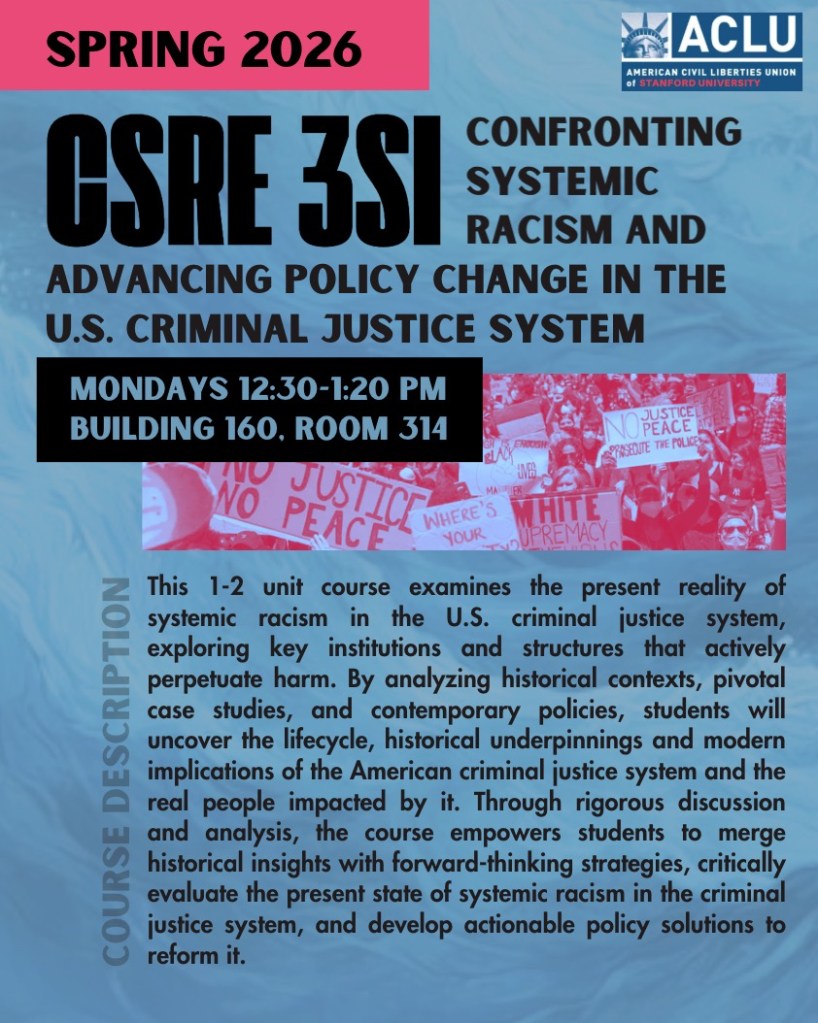
Stanford ACLU’s class flyer for CSRE 3SI
So, who can benefit from the creativity and inquisitiveness the course encourages? CSRE 3SI is open to students of all class years and academic backgrounds—freshmen included. In fact, first-years in particular may gain from a class environment like this one. Sinclair points out how the class formulation “encourages building… discussion skills that [freshmen are] going to need as [they] continue at Stanford, especially for seminar-style courses, it’s a chance to engage with an issue that really does impact everyone… and think about the ways that it does impact you, even if you don’t know it does quite yet.” Maybe you are a frosh, not quite sure what you want to major in, drawn in by the allure of so many incredible academic departments at Stanford. Or maybe you’re approaching your final spring quarter, set in your pre-law or pre-med or pre-FAANG ambitions. You have surely seen, or will soon see, the magic of collective student-directed programming at Stanford—but maybe you’re not quite sure yet how these projects turn out. The ACLU team’s message is clear: come and see for yourself.
Interviews are edited for clarity / Photo Credit: Gabrielle Karampelas
 Stanford Political Review
Leave a comment