By Emily Villa, ’27
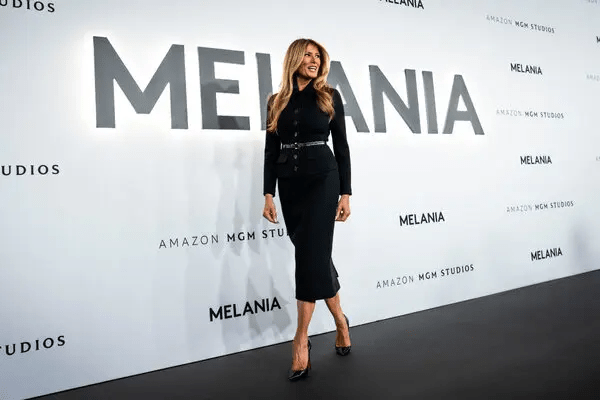
On the first weekend of the documentary’s release, Melania, the nearly two-hour-long documentary, hit movie theatres across the country with $7 million in domestic ticket sales—short a million dollars from the actual projected ticket sales. The First Lady’s documentary experienced a steep 67% drop in ticket sales during its second weekend in theatres, making it hard to justify the $40 million that Amazon spent to acquire the rights to it. While Amazon’s explanation for licensing it was that they thought “customers would love it”, this review will address my very prevalent qualms about the documentary.
In many ways, Melania Trump exists in the minds of the public as a perfectly curated figure, equal parts glamour and mystery. It seems as though each time Melania is interviewed, her answers are wholly scripted and ever-polished, yet never truly authentic. I must say, the only time I have heard Melania really “speak her mind” is through a phone call audio released by Stephanie Winston Wolkoff, the First Lady’s former confidant. In the audio, Melania frustratedly says, “ I’m working…my a** off on the Christmas stuff, that you know, who gives a f*** about the Christmas stuff and decorations? But I need to do it, right?”
To clarify, I wasn’t expecting the Melania documentary to feature the uncensored frustrations of FLOTUS, especially not if the film was produced by Melania herself. However, while watching the movie, I kept waiting for the moment when we’d see Melania relax her shoulders, pull out a makeup wipe, or even leisurely sip a glass of wine? But that moment never came; instead, what the audience received was nearly two hours of Trump propaganda.
The film was centered on the weeks leading up to Donald Trump’s second presidential inauguration, but politics was a tangential component throughout. Scenes consisted of an overwhelming depiction of wealth and lavishness, two things that Melania is evidently swaddled in. Strutting down hallways in stilettos that never come off and trying on obnoxiously tailored hats juxtaposed the supposed work of “Be Best” —Melania’s public awareness campaign pertaining to combating youth cyberbullying.
While Melania meets with Brigitte Macron, the First Lady of France, and Rania Al Abdullah, the Queen of Jordan, to discuss the expansion of “Be Best,” nothing about the campaign feels particularly genuine or rooted in material change. The conversations are vague and circle around buzzwords like “kindness,” “children,” and “cyberbullying” without ever naming a concrete policy goal or measurable impact. In fact, the scene in which Melania and Queen Rania discuss ideas for non-profits feels especially off-putting. What is framed as a sincere, collaborative exchange instead reads as a carefully staged performance of compassion. In more direct terms, this supposed heart-to-heart comes across as profoundly tone-deaf.
The most transparent moment the audience gets from Melania is the mourning of her late mother, who died in January 2024. We see her stride into a suspiciously empty Catholic church in six-inch stilettos and an elegantly tailored black coat to light a few candles, followed by a brief, almost fleeting appearance from her father. These scenes, while meant to humanize her, feel overly aestheticized. Beyond this, the film lacks any clear narrative or ideological direction. It gestures toward vulnerability and purpose but never commits to either, remaining curiously detached from the contemporary political crises it exists alongside. Ultimately, the documentary feels less like an exploration of Melania Trump as a political figure or cultural symbol and more like an exercise in controlled image rehabilitation.
If I must choose one thing that Melania does well, then I turn to the First Lady’s music taste. Surprisingly, Michael Jackson’s “Billie Jean” is Melania Trump’s ultimate anthem. In the film, the First Lady is seen partaking in a tame version of carpool karaoke to this very song, which she claims is her favorite.
What remains unclear is what Melania herself stands to gain from the project beyond financial profit. The film offers no new ideological positioning, no meaningful reframing of her public image, and no substantive engagement with the legacy of her time as First Lady. Rather than clarifying her role or reclaiming narrative control, the documentary seems content to gesture toward depth without ever arriving there. As a result, it feels less like a purposeful act of self-definition and more like an artifact of celebrity politics that exists simply because it can.
Contributor: Nason Li ‘29, Photo Credit: Doug Mills/The New York Times
 Stanford Political Review
Leave a comment